Agency Warning Signs
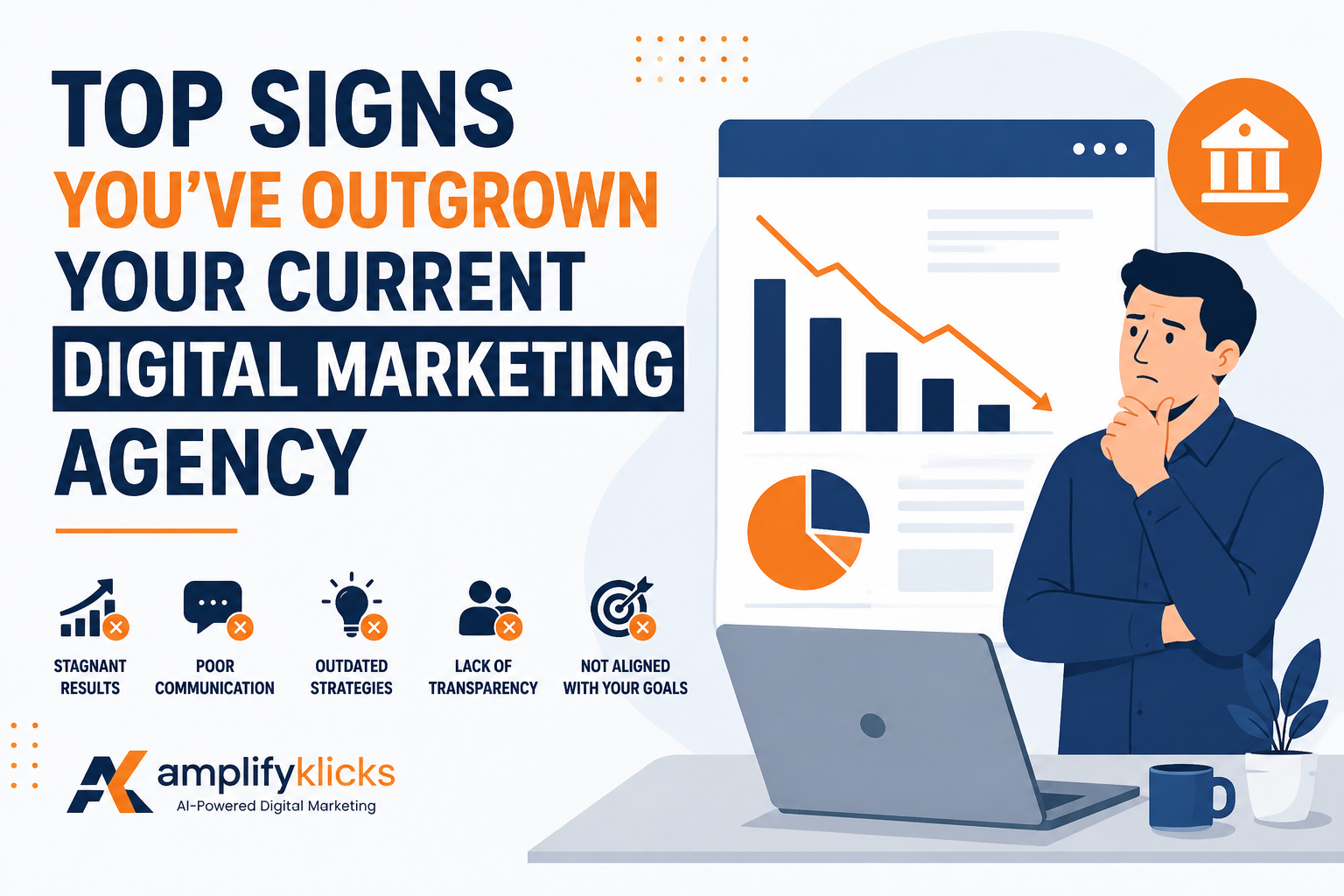
Most business owners in Vadodara don’t fire their digital marketing agency the moment things go quiet — they wait. They sit through a few flat months, a few vague reports, a few explanations about “the algorithm,” telling themselves the numbers will recover. By the time the obvious signs become impossible to ignore, an agency has often already coasted on the relationship for six, eight, sometimes twelve months without anyone formally noticing when the strategy stopped evolving. If SEO is part of what you’re paying for, switching to an SEO Company in Vadodara you can trust is often the first fix.
The signs everyone eventually catches — stagnant reports, plateaued leads, slower replies — are real, but they’re also lagging indicators. They surface months after the actual problem started. This guide covers those briefly, then goes further, into six structural signals almost no one checks for, the ones that reveal an agency has stopped actively managing your account long before your leads ever dip. If you’ve read our guide on the ten questions to ask before hiring a digital marketing agency in Vadodara, think of this as its mirror image: the questions to ask the one you already have.
- The obvious signs — flat reports, plateaued leads — are real but late. By the time you notice them, the strategy has usually been stalled for months.
- The signals that actually matter show up earlier: who controls your data infrastructure, whether your channels talk to each other, and whether anyone is tracking your AI search visibility at all.
- A 30-second test using ChatGPT or Gemini can reveal more about your agency’s real capability than any pitch deck or case study.
- Before switching, run the specific checklist in this guide — most conversations either fix the relationship or confirm it’s genuinely time to move on.
The Signs Everyone Notices — Eventually
Three patterns show up in almost every story about a stalled agency relationship: the monthly report reads the same as it did six months ago, leads have plateaued while the invoice hasn’t, and communication has slowed from prompt replies to generic check-ins. These are real signals, and if more than one applies to you, it’s worth a direct conversation. But by the time you consciously notice them, the underlying problem has usually been present for a while — these are the symptoms, not the disease.
| Surface Symptom | What It Usually Means |
|---|---|
| Same report every month | No one is actively testing new approaches on your account |
| Leads flat, invoice steady | Growth has plateaued specifically for you, not necessarily the market |
| Replies slower and vaguer | Your account has likely been deprioritized for newer clients |
The Six Signs Almost Nobody Checks For
These are the signals that show up months before the obvious ones, because they’re structural rather than performance-based. Most business owners have never thought to check any of them — which is exactly why they’re worth checking.
1. You Don’t Actually Own Your Own Data
Ask a direct question: is your Google Analytics 4 property, Search Console, Google Tag Manager container, and Google Ads account sitting under your own Google account, or under your agency’s parent management account (MCC)? If it’s the latter, you don’t fully own your own marketing data infrastructure — you’re renting access to it. This matters more than it sounds. If the relationship ends badly, an agency holding your accounts under their MCC can take weeks to release them, and in the worst cases, years of historical conversion data effectively becomes unreachable. A genuinely client-first agency sets these up under your ownership from day one, with themselves added only as a user, never the owner.
2. Your Channels Don’t Talk to Each Other
Ask your account manager one question: what did your top-converting Google Ads keyword do for your organic content plan last month? A long pause before the answer is telling. In a properly run engagement, SEO, paid, and content strategy inform each other constantly — a high-converting ad keyword should shape your next blog topic, and your best-performing organic page should shape your next ad group. When those three functions operate as separate silos reporting to you independently instead of feeding each other, you’re paying for three services, not one integrated strategy.
3. Nobody Is Tracking Whether AI Search Engines Recommend You
This is the newest blind spot, and it’s the one almost no agency in Vadodara has caught up to yet. Ask your agency directly: when someone asks ChatGPT or Gemini for the best provider of your service in Vadodara, do you show up, and how do they know? If the honest answer is “we haven’t checked,” your agency is optimizing for a search landscape that’s already partially outdated. Our Generative Engine Optimization and Answer Engine Optimization work exists precisely because of this gap — a growing share of buying research now happens inside an AI conversation that never touches a traditional results page, and an agency with zero visibility into that layer is only managing half your discoverability.
4. Your Structured Data Has Quietly Broken
If your website had schema markup implemented at any point, and most professionally built sites do, has anyone actually re-validated it since? Website redesigns, plugin updates, and CMS changes silently break structured data all the time, and unlike a broken link, nobody notices until search visibility mysteriously drops. Ask when your schema was last tested against Google’s Rich Results tool. If the answer is “at launch,” and launch was over a year ago, there’s a real chance your site has been quietly serving broken or outdated markup for months.
5. The Competitor List From Onboarding Never Changed
Pull up the competitor analysis your agency built when you first signed on. Now ask: has it been updated since? Markets shift — new competitors enter, existing ones change strategy, and a competitor set that was accurate a year ago can be actively misleading today. An agency still measuring you against the same three competitors from your kickoff call, without ever revisiting that list, has stopped actively watching the market on your behalf.
6. Requests Get Acknowledged, Never Completed
Go back through your last five specific requests — a page you asked to be updated, a tracking issue you flagged, a new service you wanted added to the site. Count how many were actually completed versus simply acknowledged with “we’ll look into that.” A pattern of polite acknowledgment without follow-through is one of the most reliable early indicators that an account has quietly slipped down an agency’s priority list, well before it shows up in your results.
The 30-Second Test You Can Run Right Now
Open ChatGPT or Gemini and ask it to recommend the best business in your category in Vadodara — or the best digital marketing agency in Vadodara, if you want to test the test itself. Two things are worth noticing: whether your own business appears at all, and whether your current agency’s own business appears when you search for their category. An agency that can’t get itself recommended by AI search engines is unlikely to be quietly excelling at getting you recommended either. It’s one of the fastest, most honest capability checks available, and it takes less time than reading this section.
| Structural Sign | What It Actually Reveals |
|---|---|
| Accounts under agency’s MCC | You don’t fully control your own historical data |
| Channels reported separately | No integrated strategy, just parallel workstreams |
| No answer on AI visibility | No process exists to track or improve it at all |
| Schema never re-checked | Structured data may be silently broken right now |
| Same competitor list for a year+ | Market monitoring has quietly stopped |
What to Do Before You Switch
Before ending any engagement, have one direct conversation. Share the specific signals from this guide, not vague dissatisfaction, but the actual checklist, and ask for a written plan addressing each one within 30 days. A results-oriented agency will respond with specifics: who owns which accounts, when structured data was last checked, what your current AI search visibility actually is. A defensive or vague response to a specific, well-informed question is usually more revealing than the original problem.
If the conversation confirms it’s time to move on, treat the transition as seriously as the original hiring decision. Our guide on the ten questions to ask before choosing a digital marketing agency in Vadodara and our broader comparison framework for evaluating agencies in Vadodara both apply here — the difference is you’re now asking with the benefit of hindsight.
As a results-driven digital marketing agency in Vadodara, we’ve had more than one client transition to us after recognizing several of these signs in their previous agency, most often the data ownership and AI visibility gaps, since those are the two agencies rarely disclose voluntarily. If you want a second opinion before deciding anything, our full range of AI-first digital marketing services includes a no-obligation audit that checks exactly the six structural signals above, not just your rankings. If you’re weighing your options, a professional SEO company for businesses in Vadodara can offer that second opinion.
Frequently Asked Questions
How do I know if it’s time to switch digital marketing agencies?
If your reporting has stayed the same for months, your agency can’t explain your AI search visibility, or you don’t have direct ownership of your own analytics and ad accounts, those are strong signals to have a direct conversation or start evaluating alternatives.
Is switching agencies risky for my SEO rankings?
A well-managed transition, where content, technical work, and structured data transfer cleanly, carries minimal risk. The bigger risk is usually staying with an underperforming agency too long while competitors keep moving.
What should I ask for before ending an agency contract?
Request full ownership access to all analytics and ad accounts, a copy of all content and reports produced, and written confirmation of any assets built specifically for your account, including structured data and tracking setups.
How do I check if my agency is tracking AI search visibility?
Ask them directly whether they monitor your business’s presence in ChatGPT, Gemini, and Google AI Overviews for your core services, and how. If they can’t describe a specific method, they likely aren’t tracking it. You can run a basic check yourself by asking an AI assistant to recommend a business like yours in your city.
Who should own my Google Analytics and Google Ads accounts, me or my agency?
You should. Your GA4 property, Search Console, Google Tag Manager container, and Google Ads account should be set up under your own Google account, with your agency added only as a user. This protects your historical data regardless of what happens to the agency relationship.
How often should structured data or schema markup be checked?
At minimum after any website redesign, CMS migration, or major plugin update, and ideally every few months as routine maintenance. Structured data breaks silently, so proactive testing against Google’s Rich Results tool is the only reliable way to catch it before it affects search visibility.
Get a free second opinion
We’ll review your current results, data ownership, and AI search visibility, no strings attached, so you know exactly where you stand before deciding anything.
Or explore: Home · All Services · Best Agency Guide · 10 Questions to Ask